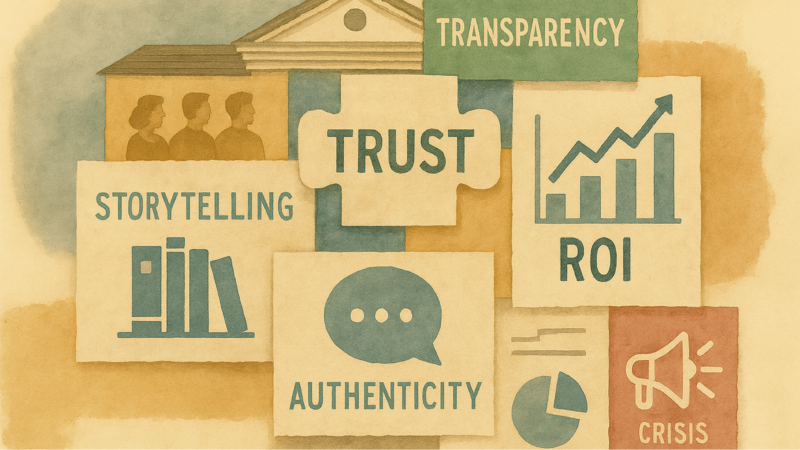
Audiences change, and higher ed leaders know it. Recruiting millennials looked very different from reaching Gen Z, and the students of tomorrow will arrive with expectations shaped by a new societal climate. Yet one constant remains: students considering college want to know they can trust an institution to help them succeed and that it’s worth their investment.
That’s not an easy promise to prove when the competition isn’t just the school down the road. Today, prospective students are comparing you against trades, community colleges, online certifications, and short-term pathways that advertise affordability and speed. To stand out, higher ed institutions must design student journeys that feel personal, flexible, transparent, and responsive to modern learners with communications that meet them exactly where they are.
Prospective students of today are no longer walking through an enrollment funnel; they’re navigating a maze. They have more choices, more information at their fingertips, and higher expectations than ever before because of social media. At the click of a button, they can know what thousands of people say about your institution, how much it costs compared to a community college down the road, and even consider ROI before they submit an application.
Many also balance work, family, or their responsibilities alongside school. If your institution isn’t meeting them where they are by offering the right information at the right time, they’ll move on to one that does. Understanding this situation is the first step toward designing student journeys that actually work.
For higher ed leaders, that means a simple website or glossy brochure isn’t enough anymore. Colleges and universities that carefully focus on making each student’s experience clear, convenient, and tailored to their needs tend to do better at attracting students to enroll and keeping them active in their alma mater years down the road.
For some background, a marketing funnel is the path a prospective student takes from first hearing about your school to becoming a fully enrolled—and eventually graduated—student. We think of it like a funnel because a large chunk of potential students will enter at the top when they first hear about your institution, and fewer make it through each stage until the end. The goal is to guide them smoothly through each step so more students succeed and stay engaged.
Here’s a breakdown of a marketing funnel for a recruitment campaign, stage by stage, and why each touchpoint matters:
This is when students first hear about your institution through Google searches, social media campaigns, news articles, or other forms of media. Your goal is to spark curiosity and show why your school might be a good fit.
Students start asking questions or requesting more information. They might attend an open house, download a program brochure, or chat with admissions. This is your chance to provide clear, personalized information and begin building trust.
Applying is a big step. Students weigh program options, costs, and outcomes. Any friction—like confusing forms or unclear deadlines—can cause them to give up. Your job is to simplify the process and guide them every step of the way to applying.
Once accepted, students make their final choice. Transparency about tuition, financial aid, and campus life is important to help them feel prepared with their final decision.
Retention is about keeping students engaged and supported throughout their time at your institution. Academic advising, career counseling, student activities, and new programs or opportunities can all help students feel connected and confident that they are getting the best learning experience possible.
A strong student journey leads to graduation and beyond. Alumni engagement, career support, and ongoing communication should turn graduates into advocates who influence the next wave of prospective students.
Mapping these stages forces you to see the experience through a student’s eyes. Where are they excited? Where do they stall? Where do they disappear altogether? By identifying every touchpoint and crafting emails, social media interactions, website landing pages, and more, you can see where students are engaging with your institution and where they might be dropping off.
And knowing where prospects frequently abandon applications will signal to rethink messaging or introduce information earlier in the process. Ultimately, improving these touchpoints and being as specific to your audience as possible will leave them with one clear answer: You’re the institution for me.
One size no longer fits all. Today’s learners expect communication that reflects their unique goals and circumstances. A high school senior interested in robotics is looking for engineering programs with cutting-edge labs and faculty research. A working parent considering nursing wants to know if evening classes and clinical placements can fit around their schedule. Both are prospective students, but their needs and the way you reach them are entirely different.
Data is your friend here. Tracking demographics, interests, and behaviors allows you to segment your audiences and deliver messaging that feels specific to them. And specificity matters: when a student sees an email or landing page that reflects their exact situation, it feels less like a broadcast and more like a conversation. Tailoring your communication not only increases engagement but also reduces friction in decision-making.
Flexibility is more than offering evening classes. Modern learners want options that fit their lifestyles: hybrid programs, online courses, microcredentials, and stackable learning pathways. These options give students more control over how and when they learn and signal that your institution understands real-world constraints.
Institutions that embrace flexibility can expand their reach beyond the traditional student body. Parents, full-time workers, and career-changers are more likely to enroll if they see programs designed to meet their needs. Flexibility is absolutely a perk, but it’s also a recruitment and retention strategy.
Cost is often the first major roadblock in a student’s journey. But transparency isn’t just about publishing tuition numbers—it’s about contextualizing them. Prospective students and their parents want to understand the full cost of attendance, available financial aid, and potential return on investment.
Research from BestColleges.com showed that over 50% of students consider cost, and close to 40% consider career outcomes before applying. When students understand the value of their investment, they’re more likely to commit and persist through graduation. It’s important for institutions to communicate clearly about scholarships, work-study options, and average post-graduation salaries. With a clear understanding of costs, aid, and potential outcomes, students are in a better position to explore the programs that fit their goals.
Microcredentials and stackable programs are changing how students and their families think about higher education. Rather than committing to a multi-year program upfront, learners can take smaller, targeted courses that stack toward a degree or certification. This flexibility is a powerful selling point for prospective students, especially those balancing work, family, or other responsibilities.
For example, an IT student might complete a cybersecurity microcredential while working toward a full degree in information systems. These smaller milestones give learners immediate results rather than committing to a full four-year term. From a marketing perspective, highlighting these options shows that your institution offers practical, achievable pathways rather than asking for a long-term commitment from day one.
Stackable programs also broaden your institution’s reach. They attract non-traditional learners and professionals seeking skill upgrades. Learners can see immediate results from their investment, and so can your institution. You’ll improve enrollment from those who might not otherwise enroll, and provide a stronger pathway to lifelong learning.
Even the most thoughtfully designed student journey requires careful tracking and iteration. Metrics matter. Track at each touchpoint: inquiry-to-application conversion rates, open and click-through rates on communications, application abandonment points, and retention data all tell a story about student behavior. Using data to measure performance allows your marketing team to fix friction points and optimize the experience. If a particular communication channel underperforms, it might be a case of trying a different message, format, or timing. Iteration is key because student behavior evolves, and your strategies need to evolve with it.
We’ve been fortunate to work alongside higher education institutions for two decades, helping them design enrollment campaigns that result in strong enrollment numbers. The results speak for themselves, and we’d love to help your institution do the same.
From personalized branding, messaging, implementation, and transparent communications, we handle it all. Talk to Frankel today about what we can do for your higher ed institution.
Let’s talk about how Frankel can help you launch smarter, move faster, and grow stronger.

Full-service higher education marketing
© 2025 Frankel: Higher Ed. All rights reserved.